.png)


%20(1).png)
Alive, Fit & Free Journal
Helping People Live Better for Longer™
The Science Behind Neuro.Up
How Joyful Brain-Body Training Supports Cognitive Health and Quality of Life
For many years, people were told that the brain simply declined with age and that little could be done about it. If brain cells were damaged or lost, the assumption was that those changes were permanent.
Today, science offers a more hopeful perspective.
Research shows that the brain can adapt, reorganize, and strengthen connections throughout life. This capacity is called neuroplasticity, and it is one of the foundational principles behind Neuro.Up.
Unlike traditional exercise programs that focus primarily on muscles, endurance, or calories burned, Neuro.Up intentionally engages the brain and body together in meaningful, real-world ways.
That matters because the brain does not work in isolation. It responds to movement, rhythm, attention, repetition, emotion, social engagement, and environment.
Neuro.Up brings these elements together in a practical, engaging approach to lifelong wellness.
Neuroplasticity and Aging
Neuroplasticity is the brain’s ability to reorganize its connections and strengthen communication between brain cells.
Whenever we learn something new, coordinate an unfamiliar movement, practice a skill, or solve a problem, the brain responds by adapting its networks.
Research involving older adults suggests that targeted cognitive training can improve certain areas of cognitive performance, including attention, working memory, and processing speed. Motor learning can also produce changes in brain activity and the networks involved in movement and coordination.
In other words, the aging brain is not simply “done.”
It remains capable of learning and adaptation, especially when challenged appropriately and supported through consistent practice.
%20(2).png)
Why Movement Matters for the Brain
Movement is one of the most effective ways to engage multiple systems in the brain and body simultaneously.
Even a simple movement pattern may require balance, coordination, timing, sensory awareness, planning, and decision-making.
Physical activity also supports cardiovascular health and blood flow, and research associates regular activity with better cognitive health, mood, sleep, and physical function. Maintaining an active lifestyle is an important part of a comprehensive approach to healthy aging and dementia risk reduction.
That is one reason Neuro.Up is built around purposeful movement rather than passive activity.
The goal is not simply to exercise. It is to challenge the brain and body together in ways that are relevant to everyday life.
Neuro.Up’s Whole-Brain Approach
One of the defining features of Neuro.Up is its integration of multiple forms of stimulation rather than separating physical exercise from cognition, emotion, or social connection.
A typical session may incorporate:
- Rhythmic and patterned movement
- Cognitive challenges, such as remembering sequences or responding to cues
- Music and rhythm
- Breathwork and relaxation strategies
- Coordination and cross-body exercises
- Balance training
- Social interaction and emotional connection
- Mind-body awareness
Research on combined motor-cognitive training suggests that engaging physical and mental tasks together can benefit aspects of attention, executive function, balance, and dual-task performance, particularly in older adults.
Neuro.Up translates these principles into engaging activities that can be adapted to different ability levels.
Dual-Task Training and Cross-Body Movement
Daily life is full of dual-task moments: walking while talking, turning while thinking, or carrying something while paying attention to the environment.
When the ability to manage these tasks becomes more difficult, everyday activities can feel less stable, more demanding, or overwhelming.
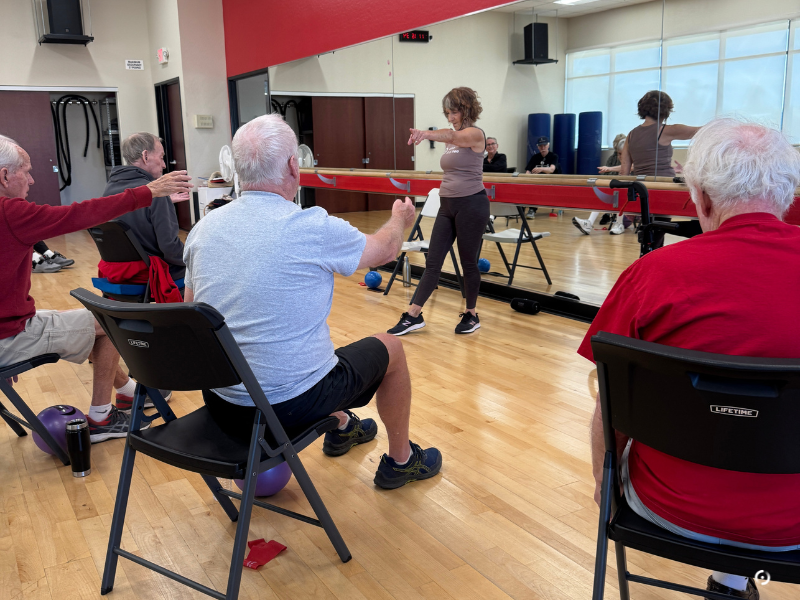
That is why Neuro.Up intentionally incorporates dual-task training: performing a physical task while also engaging the mind.
Participants might step through a movement pattern while naming categories, respond to colors or numbers while moving, or coordinate opposite arm and leg movements while listening for cues.
Research suggests that motor-cognitive training can improve aspects of gait, balance, attention, and cognitive performance in older adults, including some individuals experiencing mild cognitive impairment.
Cross-lateral, or cross-body, movement is another important component of Neuro.Up.
These movements cross the body's midline, such as bringing the right hand toward the left knee. They challenge coordination between the two sides of the body and engage networks involved in motor planning, timing, spatial awareness, and attention.
The result is a movement experience that challenges more than muscles alone.
Rhythm, Music, and Nervous-System Regulation
Music and rhythm are woven into Neuro.Up because they engage multiple brain systems involved in movement, attention, memory, and emotion.
Rhythm can provide helpful timing cues, support movement initiation, and make coordinated activity more engaging. Familiar music may also evoke memories and emotional responses.
This is one reason music-based movement can feel uplifting while supporting participation and connection.
Equally important is the nervous system.
Stress, anxiety, and emotional overload can affect attention, sleep, mood, and the ability to participate comfortably in daily activities. These challenges can be particularly significant for individuals living with neurological conditions and for caregivers.
The parasympathetic nervous system is associated with the body's rest-and-recovery functions. Slow breathing, calming movement, positive social interaction, and relaxation practices can support a greater sense of calm and help regulate the body's stress response.
Neuro.Up incorporates these elements through breathing, rhythm, grounding movement, laughter, and encouragement.
We believe that people learn and participate best when they feel welcomed, supported, and safe to try.
Three Neuro.Up Pathways: One Brain-Body Philosophy
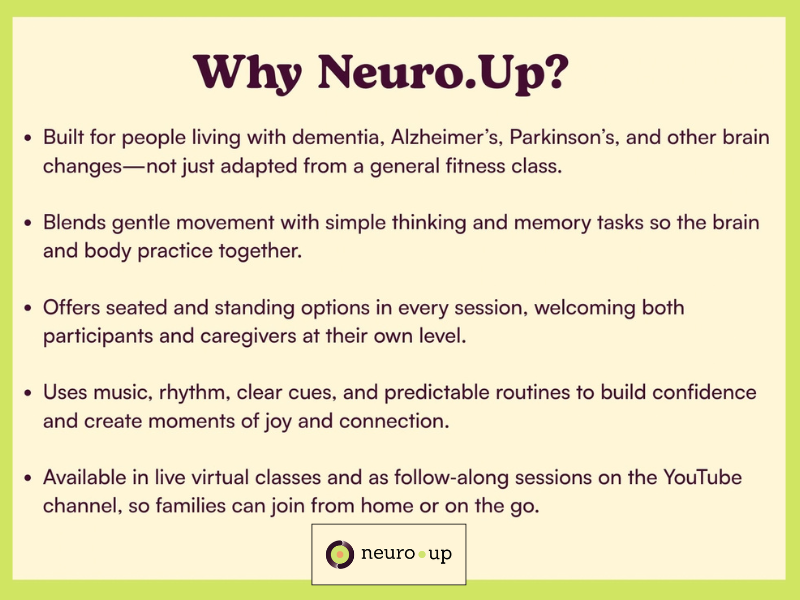
Neuro.Up applies its brain-body training principles through three specialized pathways. Each is designed around the needs, goals, and experiences of a different population.
Although the activities and adaptations vary, all three share the same foundation: purposeful movement, cognitive engagement, accessibility, social connection, and joy.
Neuro.Up for Parkinson’s
Parkinson’s is a progressive neurological condition that can affect movement, balance, coordination, and other aspects of daily life. Some individuals also experience changes in attention, mood, sleep, and cognitive function.
For many people, movement can become less automatic. Initiating a step, changing direction, coordinating multiple actions, or responding to environmental demands may require greater concentration.
Neuro.Up for Parkinson’s is designed to help participants practice the movement and cognitive skills that support everyday function and confidence.
Sessions may incorporate:
- Rhythmic movement and external cueing
- Large-amplitude movements
- Balance and coordination activities
- Cross-body patterns
- Cognitive-motor challenges
- Weight shifting and directional changes
- Breathing, relaxation, and positive social engagement
Activities are adapted to individual abilities, with seated, supported, and standing options as appropriate.
The intention is to create a welcoming environment where participants can practice movement, challenge their brains, build confidence, and remain engaged in life.
Neuro.Up is a wellness and movement education program, not a replacement for medical care, physical therapy, or an individualized Parkinson’s treatment plan.
Neuro.Up for Alzheimer’s and Dementia
Alzheimer’s disease and other forms of dementia can affect memory, communication, attention, orientation, and the ability to manage everyday activities.
But a diagnosis does not erase a person's identity, emotions, preferences, or capacity for meaningful connection.
People living with dementia continue to benefit from opportunities for movement, music, social engagement, and activities that offer enjoyment and a sense of accomplishment.
Neuro.Up for Alzheimer’s and Dementia emphasizes accessible, supportive brain-body experiences that meet people where they are.
Sessions may incorporate:
- Familiar music and rhythmic movement
- Simple, repeatable movement patterns
- Gentle coordination activities
- Sensory engagement
- Positive social interaction
- Breathing and calming strategies
- Adaptations that reduce frustration and encourage participation
Rather than emphasizing performance or getting every movement right, the focus is on engagement, dignity, enjoyment, and connection.
Caregivers are an important part of this pathway. They may benefit from learning simple ways to participate in movement together, encourage engagement, and create positive shared experiences.
Neuro.Up does not claim to reverse dementia or stop disease progression. Its purpose is to support quality of life, participation, movement, and meaningful human connection.
Neuro.Up for Active Agers
Healthy aging is about more than living longer. It is about maintaining the ability to participate in the activities, relationships, and experiences that make life meaningful.
As we age, maintaining strength, balance, mobility, cognitive engagement, and confidence becomes increasingly important.
Neuro.Up for Active Agers brings brain training and purposeful movement together to help people stay engaged, capable, and curious throughout life.
Sessions may incorporate:
- Functional strength and mobility
- Balance and fall-prevention skills
- Cross-body coordination
- Memory and sequencing challenges
- Reaction time and decision-making
- Rhythm and creative movement
- Social connection and emotional wellness
The goal is to help participants practice skills that matter in everyday life: navigating their environment, changing direction, remembering information, responding to unexpected situations, and continuing to explore new interests.
Neuro.Up for Active Agers is not about slowing down life. It is about preparing the body and brain to keep participating in it.
Whether someone wants to travel, dance, garden, play with grandchildren, or simply feel more confident moving through the day, the emphasis is on maintaining independence and living better for longer.
Multidomain Support for Cognition and Quality of Life
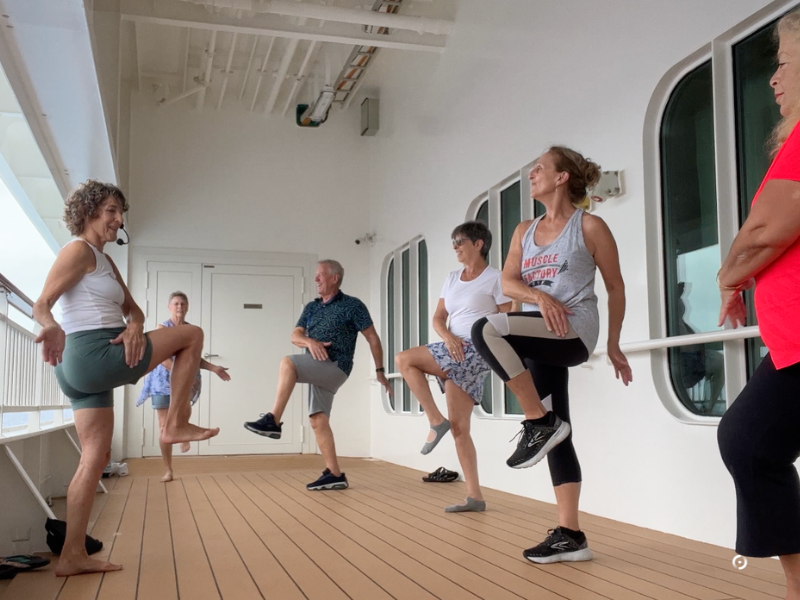
Neuro.Up’s integrated philosophy is consistent with research into multidomain approaches to brain health.
The FINGER study examined a combination of physical activity, cognitive training, nutrition, and vascular risk management and found benefits in cognitive performance among older adults at risk for cognitive decline.
The U.S. POINTER trial also reported cognitive benefits from structured multidomain lifestyle interventions in older adults at increased risk of cognitive decline.
Neuro.Up is not either of these research interventions, and those findings should not be interpreted as proof of Neuro.Up-specific outcomes.
However, the research reinforces an important principle: brain health is influenced by multiple interconnected factors, and a comprehensive approach can be more meaningful than focusing on a single activity alone.
Brain-body programs can also support emotional well-being. Physical activity is associated with better mood, while group participation offers opportunities for social connection, confidence, and reduced isolation.
When someone learns a new movement, remembers a sequence, or discovers that they can do something they once found difficult, it can create a powerful sense of accomplishment.
And that sense of possibility matters.
Accessibility and Joy Matter
A core goal of Neuro.Up is accessibility.
Classes include seated options, standing options, supported movement choices, and adaptations for different ability levels. Participants are encouraged to move at their own pace and honor what their body and brain need that day.
Joy is not an afterthought. It is part of the methodology.
Laughter, music, encouragement, rhythm, and social connection can help people feel motivated to return and continue practicing. Consistency matters because many of the benefits associated with physical and cognitive training develop through ongoing participation.
We want people to leave class feeling that they have done something good for themselves — physically, mentally, emotionally, and energetically.
Why Neuro.Up Fits Both Science and Real Life
Taken together, research supports several important ideas:
- The brain retains the capacity to adapt throughout life.
- Physical activity supports cognitive and emotional health.
- Dual-task and coordinated movement can help develop skills relevant to everyday function.
- Music and rhythm can support movement, engagement, and emotional connection.
- Social participation and multidomain wellness approaches are important components of healthy aging.
That is where Neuro.Up lives.
It brings together brain-smart movement, cognitive challenge, rhythm, breath, social connection, accessibility, and joy in one human-centered methodology.
Whether supporting active aging, people living with Parkinson’s, or individuals experiencing Alzheimer’s and dementia, Neuro.Up is built around a simple belief:
We are not just training bodies. We are creating opportunities for people to keep learning, connecting, participating, and living fully.
Bring Neuro.Up Into Your Professional Practice
Neuro.Up is also available as a professional training, certification, and licensing opportunity for fitness professionals, wellness practitioners, and organizations serving older adults.
Explore the three specialized pathways:
- Neuro.Up for Active Agers
- Neuro.Up for Parkinson’s
- Neuro.Up for Alzheimer’s and Dementia
Through Neuro.Up training and certification, professionals can expand their knowledge and bring a structured, brain-body approach to the people and communities they serve.
Participants may submit course documentation to their respective certifying organizations for consideration of continuing education credits, subject to each organization's requirements.
Interested in Neuro.Up Certification & Licensing?
Vickie
Alive, Fit & Free
Live Better for Longer.
%20(3).png)